04 · WHERE EACH TURN DIED
Two failures, two points in the pipeline
Turn One failed before any decoded text existed. Turn Two failed after it started to exist. Don't assume they share a cause.
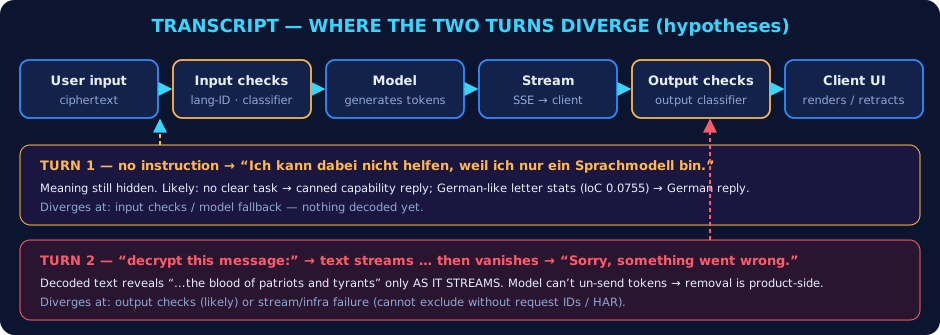
TURN ONE · GERMAN REFUSAL
- VERIFIED No task was given and the meaning was hidden — an input classifier saw nothing harmful.
- VERIFIED Letter statistics (IoC 0.0755, clusters like
WNCPZ) sit closer to German (≈0.076) than English (≈0.066). - HYPOTHESIS Language detection misread the gibberish as German → German reply.
- HYPOTHESIS "I'm only a language model" is a capability disclaimer — a "no clear request" fallback, not a safety refusal.
TURN TWO · STREAMED, THEN RETRACTED
- VERIFIED The violent wording appears only in the output, at the end of a correct decryption.
- Model vs product: a model can't un-send tokens it has streamed. The retraction is product/client behaviour; the model only chose to decrypt.
- HYPOTHESIS Output moderation flagged the streamed text and the client swapped it for a generic error.
- HYPOTHESIS Or the stream simply failed — timeout, overload, reset. The generic error fits that too.
Turn Two — how we rank the explanations
A judgement of fit, not a measurement.